
Shutter and Frame Alternative for Landscape Art
Table of Contents
- Why Unframed Landscape Art Is the 2026 Standard
- Canvas, Metal, or Acrylic: Material Specifications for Wall Art
- Metal vs Acrylic Prints for Landscapes: A Direct Comparison
- Benefits of Limited Edition Fine Art Prints
- How to Display Fine Art Photography Without Heavy Frames
- Decorative Shutter-Style Wall Decor and DIY Alternatives
- Maintenance and Cleaning of Shutter-Style Frames
- Conclusion
- Frequently Asked Questions
Last Updated: September 29, 2026
Why Unframed Landscape Art Is the 2026 Standard
Unframed art has become one of the easiest wall upgrades of 2026, and landscape photography sits at the center of that shift. According to Decoist's 2026 wall trend analysis, collectors are increasingly choosing "no frame" options with painted canvas sides that echo the artwork's own color palette. At Bob Clark Photography, we see the same thing in our own orders: buyers want the image to carry the room, not the molding around it.
The reason is simple. A heavy traditional frame competes with the photograph for attention. An unframed canvas print, by contrast, lets the scene do the talking. For wide Rocky Mountain vistas and quiet coastal horizons, that restraint matters.
This guide covers the shutter and frame alternative for landscape art, from material specs to hanging hardware, so you can pick the right format the first time.
Canvas, Metal, or Acrylic: Material Specifications for Wall Art
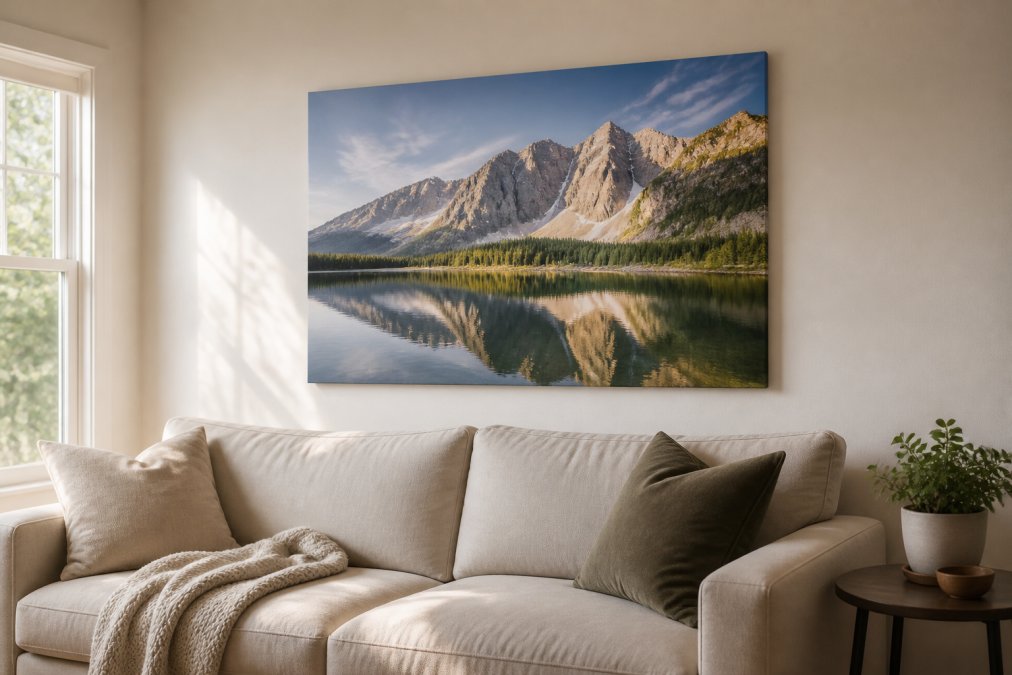
Canvas, metal, and acrylic are the three primary alternatives to traditional framing, and each one changes how a landscape reads on the wall. Canvas, metal, and acrylic are the three primary alternatives to traditional framing, and each one changes how a landscape reads on the wall.
Material choice drives durability, weight, and cost more than any other decision. Here is what actually differs.
Canvas Prints
- Construction: Cotton-poly or poly-cotton blend stretched over a kiln-dried pine or fir stretcher bar, typically 1.25 to 1.5 inches deep for a gallery wrap.
- Weight: A 24-by-36-inch stretched canvas usually lands between 3 and 5 pounds, which is why it hangs on a single sawtooth hanger or a pair of D-rings.
- Finish: Matte by default; a satin or gloss varnish adds UV and moisture protection at a small cost premium.
- Best for: Oversized art, rooms with imperfect walls, and buyers who want a warm, painterly texture.
- Watch for: Sagging over time in humid rooms, and dust that settles into the weave.
Metal Prints
- Construction: Dye sublimation infuses the image into a coated aluminum sheet, commonly 1/16 inch thick, with a float mount or aluminum backing frame on the reverse.
- Weight: Lighter than acrylic at the same size, and rigid enough to hang flat without a stretcher.
- Finish: Available in matte, satin, and high-gloss; gloss amplifies contrast but also reflections.
- Best for: High-contrast skies, sharp detail, bathrooms, kitchens, and any wall that sees humidity.
- Watch for: Visible seams on very large panels, and edge glare under direct downlights.
Acrylic Prints
- Construction: The print is face-mounted behind a clear acrylic sheet, often 1/8 to 1/4 inch thick, with a backing panel and standoff or float hardware.
- Weight: The heaviest of the three at a given size because of the acrylic sheet, so plan on two anchors minimum.
- Finish: Glossy and glass-like, with strong color saturation and depth.
- Best for: Controlled-light spaces such as hallways, dining rooms, and galleries.
- Watch for: Fingerprints, scratching during cleaning, and glare in direct sun.
How the Three Compare at a Glance
| Factor | Canvas | Metal | Acrylic |
|---|---|---|---|
| Typical depth | 1.25-1.5 in | 1/16 in panel | 1/8-1/4 in sheet |
| Relative weight | Light | Light | Heaviest |
| Moisture tolerance | Low | High | Moderate |
| Glare risk | Low | Medium-high | High |
| Cleaning difficulty | Low | Low | High |
| Relative cost | Lowest | Mid | Highest |
Bob Clark Photography's overview of canvas alternatives notes that metal, acrylic, and specialized paper prints are being positioned as durable, archival replacements for traditional canvas.
Metal vs Acrylic Prints for Landscapes: A Direct Comparison
Metal prints win for high-contrast landscape photography; acrylic prints win when you want depth and color saturation. The trade-off comes down to lighting and budget.
| Feature | Metal Print | Acrylic Print |
|---|---|---|
| Finish | Matte or glossy, reflective | Glossy, glass-like depth |
| Weight | Light | Heavier |
| Best lighting | Diffused, indirect | Controlled, low-glare |
| Durability | Scratch and moisture resistant | Scratch prone, needs care |
| Best for | Vivid skies, sharp detail | Rich color, dramatic depth |
If your wall gets direct afternoon sun, metal is the safer pick. Acrylic looks stunning in a hallway or dining room where you control the light.
Benefits of Limited Edition Fine Art Prints
Limited edition fine art prints carry a defined print run and a level of scarcity that open-edition reproductions cannot match. That scarcity is the whole point: once the edition sells out, no more are produced.
Fine art photography is the practice of creating images intended as collectible artwork rather than commercial or documentary output.
How to Display Fine Art Photography Without Heavy Frames
Displaying photography without heavy frames comes down to various formats that avoid the weight and cost of traditional custom framing.
A common mistake is buying a print before measuring the wall.
Bob Clark Photography offers prints in framed and unframed formats.
Decorative Shutter-Style Wall Decor and DIY Alternatives
Decorative shutters can frame a landscape print without a traditional picture frame. The look borrows from coastal and Mediterranean interiors, where louvered wood panels and weathered finishes soften a room.
Where to Source Salvaged Shutters
The best raw material is architectural salvage, not new retail. A few reliable channels:
- Habitat for Humanity ReStores stock donated louvered shutters, often in mismatched pairs, for a fraction of new retail.
- Facebook Marketplace and estate sales turn up full sets when older homes are renovated; search "louvered shutters" and filter by local pickup.
- Architectural salvage yards carry the widest size range but price by the piece, so measure before you commit.
- New unfinished shutters from a home center are the fallback when you need a matched pair in a specific size.
Three Builds, Step by Step
1. Salvaged shutter pair (triptych). Mount two narrow shutters vertically on either side of a canvas print so the print becomes the center panel. Measure the print's height, then cut or select shutters within 2 to 4 inches of that height so the trio reads as one unit. Attach each shutter to the wall with two anchors, then hang the canvas on a cleat between them.
Style Matching: Which Shutter Works Where
Shutter frames are not one aesthetic. Match the finish to the room:
- Farmhouse: Chippy white or raw pine shutters, matte finish, paired with muted field or barn landscapes.
- Coastal: Weathered gray or whitewashed shutters, soft seascapes or dune scenes, light and airy palettes.
- Industrial: Black or dark-stained shutters with exposed hardware, paired with moody mountain or urban-edge landscapes.
- Mediterranean: Warm terracotta or olive-toned shutters, sun-bleached desert or vineyard scenes.
Maintenance and Cleaning of Shutter-Style Frames
Shutter-style frames need dusting every two to four weeks, and a damp microfiber cloth handles most cleaning without damaging the finish. The louvered slats trap dust in a way flat frames do not, so a soft brush or a vacuum with a brush attachment is the fastest way to clear the gaps.
A few rules keep the finish intact:
- Never spray cleaner directly onto painted or stained wood; spray the cloth instead.
- Avoid alcohol-based products on acrylic prints, which can cloud the surface.
- For canvas, use a dry soft brush only. Water can stain the weave.
- Check mounting hardware twice a year. Screws loosen as wood expands and contracts.
Conclusion
Most buyers overthink the frame and underthink the print. Get the image and the material right, and the display almost takes care of itself.
Frequently Asked Questions
What can I use instead of a traditional picture frame for landscape art?
You can display landscape art without a frame using various options. Each option provides a clean, contemporary aesthetic that works well with coastal decor, Mediterranean style, and modern interiors.
How do I display fine art photography without damaging my walls?
Removable adhesive hooks can hold lightweight prints without nails. For heavier pieces, use a wall-mount system that distributes weight. If you rent, choose smaller sizes or lightweight materials. Always check the weight limit of your hanging hardware and use a level to ensure the piece sits straight.
What is the difference between metal and acrylic prints for landscape art?
Metal prints are made by infusing dyes into a rigid aluminum sheet, resulting in a durable, scratch-resistant surface with a slight sheen. Acrylic prints involve printing on paper and mounting it behind a sheet of acrylic, which adds depth and a glossy finish. Both are excellent alternatives to traditional framing.
How do I clean and maintain shutter-style frames or unframed prints?
For unframed prints, dust gently with a dry microfiber cloth. Avoid liquid cleaners, which can damage the surface. Always test a small area first and never spray cleaner directly onto the art.
Are limited edition fine art prints worth the investment?
Limited edition prints are produced in a fixed number. They hold more value than open-edition prints because they are scarce. If you appreciate landscape art and want a piece that stands out, a limited edition print is a worthwhile choice.
The challenge with landscape art is rarely finding a beautiful image. It is choosing a format that fits your space, your light, and your budget without a custom framing bill. Bob Clark Photography solves that with unframed and framed prints, limited edition fine art photography, and a curated catalog of Rocky Mountain west and coastal scenes shot by an actual photographer. Get started with Bob Clark Photography and bring a piece of the West home.