
Shutter and Frame Alternatives for Gifts: 2026 Guide
Table of Contents
- Why Frame Alternatives Are Reshaping Gift-Giving in 2026
- Unframed Photo Display Ideas That Actually Look Finished
- Canvas Wraps, Photo Blocks, and Shadow Boxes: A Cost and Longevity Comparison
- How to Gift Photography Prints Without the Awkwardness
- Shipping and Preservation Logistics for Unframed Art Gifts
- Sustainability and Archival Quality: Making a Gift That Lasts
- Conclusion
- Frequently Asked Questions
Last Updated: September 15, 2026
Why Frame Alternatives Are Reshaping Gift-Giving in 2026
Personalized gifting is now a $40.16 billion global market, growing at 8.5% to 10.2% annually, according to Beyond Memories' State of Personalized Gifting 2026. That growth is changing what people expect from a photography gift. Shutter and frame alternative for gifts is no longer a niche workaround for renters or small budgets. It is a deliberate style choice, and the numbers back it up: nearly one in four shoppers set firm spending limits for holiday gifting in 2026, making practicality and price the deciding factors at checkout (Talker Research's 2026 holiday gifting survey).
Buyers still want the drama of a Montana sunrise or a bighorn sheep on a ridgeline, but increasingly on a photo ledge, a canvas wrap, or a tabletop easel rather than behind glass.
This guide covers frame alternatives, how long each lasts, and how to package one so it arrives intact, including the shipping details most gift guides skip.
Unframed Photo Display Ideas That Actually Look Finished
Unframed photo display ideas work best when the print itself carries visual weight. A loose print on a bare wall looks unfinished. The same print on an easel, a ledge, or a magnetic strip looks intentional. The difference is mounting, not framing.
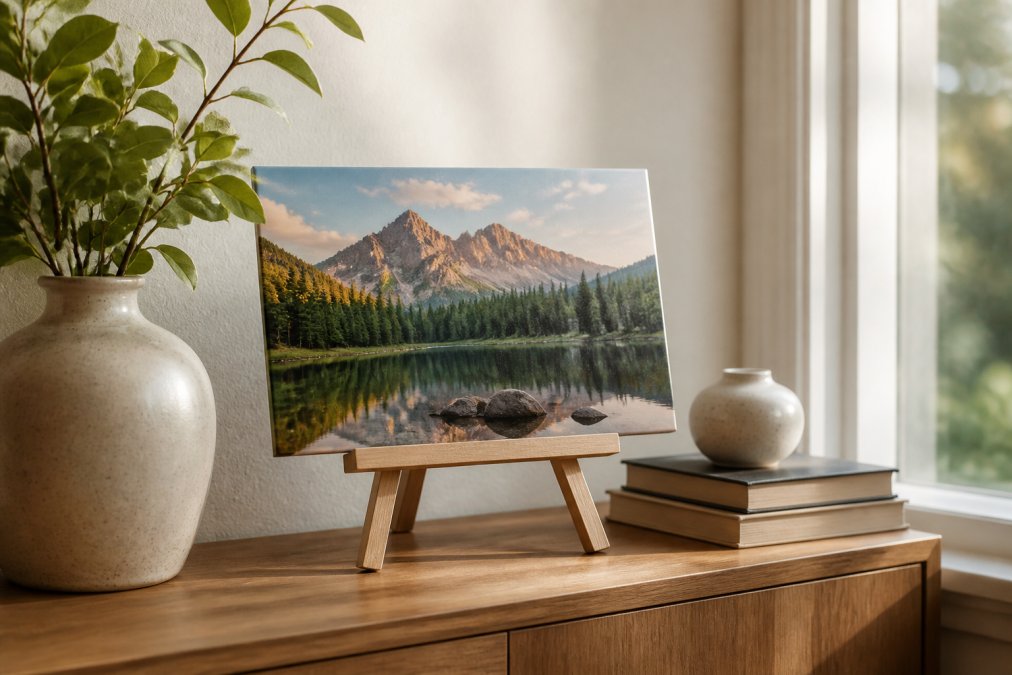
Tabletop Displays: Easels, Photo Blocks, and Rotation
Tabletop display is the fastest-growing category in this space, largely because it lets people rotate images without permanent hardware. Artifact Uprising's 2026 trend notes highlight small easels as a way to swap prints seasonally, so a single shelf can hold a winter elk shot in January and a wildflower meadow in June (Artifact Uprising's display trend report).
Three options dominate:
- Easel stands. An 8x10 or 11x14 print on a wood or brass easel costs a fraction of custom framing and moves room to room.
- Photo blocks. A print mounted on a thick block stands on its own, no easel needed. These suit shelves and nightstands.
- Photo ledges. A shallow ledge holds several prints at once and lets you overlap sizes for depth.
Print rotation is the real benefit: you are not committing wall space or a security deposit to one image.
Wall-Mounted Options: Magnetic Strips, Clip Rails, and Photo Ledges
For wall decor without nails, magnetic paper and adhesive strips are the practical answer. A magnetic strip holds a print flat and releases it in seconds; clip rails do the same for heavier stock. Both avoid hanging hardware entirely, which matters if you rent.
A gallery wall does not require frames either. Mixing a canvas wrap, two unframed prints on a ledge, and one small photo block creates the same composition with more texture and less cost.
Canvas Wraps, Photo Blocks, and Shadow Boxes: A Cost and Longevity Comparison
Canvas wraps, photo blocks, and shadow boxes sit at three price points and three lifespans. Canvas wraps are the mid-tier workhorse: stretched over a wooden frame, ready to hang, no glass or matting. Photo blocks are the budget option; shadow boxes are the luxury tier, built to hold dimensional art and objects.
Beyond Memories' 2026 trend analysis identifies canvas wraps, photo blocks, and 3D photo crystals as the fastest-growing alternatives to standard frames (Beyond Memories' 2026 display trends).
| Format | Relative Cost | Longevity | Best For |
|---|---|---|---|
| Photo block | Lowest | 5-10 years | Shelves, desks, small spaces |
| Canvas wrap | Mid | 10-20 years | Living rooms, statement walls |
| Photo ledge | Low | Print-dependent | Renters, frequent rotation |
| Shadow box | Highest | 20+ years | Keepsakes, dimensional objects |
Budget-Tier vs. Luxury-Tier: What You Get at Each Level
The budget tier buys flexibility. A photo block or easel-mounted print lets you change the display whenever you want and survives a move in a padded box. What you give up is surface protection: an unframed print is exposed to dust, sunlight, and fingerprints.
The luxury tier buys permanence. A shadow box with archival matting protects the print from UV damage and physical contact, and it can hold objects a frame cannot, such as a pressed flower from a trip or a pair of hiking tags. Framebridge built a scalable business on exactly this idea, expanding custom framing to "ordinary objects" like recipe cards and scarves to make them giftable (Food52's coverage of Framebridge's expansion).
That is the trade-off in one line: budget buys rotation, luxury buys time.
What Actually Drives the Price at Each Tier
Cost tracks three variables, not print size alone:
- Substrate and mounting. A photo block is a print adhered to a dense block, minimal labor and material. A canvas wrap adds a hand-assembly step: stretching over a built wooden frame. A shadow box adds a fabricated box, interior matting, and often glazing.
- Glazing and barrier layers. Glass or acrylic is the biggest cost jump between an unframed and a framed print. Canvas wraps and photo blocks skip it entirely, which is why they undercut framing at comparable sizes.
- Archival materials. Acid-free mat board, UV-filtering glazing, and backing boards rated for long-term contact with the print all add cost. A shadow box built with these can run several times the price of the same print on a block.
The pattern: the display format, not the print, is where the money goes. The same 11x14 image can be a low-cost block, a mid-tier canvas, or a high-end shadow box depending entirely on how it is mounted.
How Each Format Affects Long-Term Archival Quality
Longevity is not just about the paper. It is about what touches the paper and what the paper is exposed to.
- Photo blocks and easel prints sit in open air. Dust settles on the surface and handling transfers oils from fingers, making them the most exposed option. Expect visible wear sooner in high-traffic rooms.
- Canvas wraps are coated and stretched, giving the surface some resilience, but the coating and canvas are sensitive to prolonged direct sun. They resist fingerprints better than a bare print but still fade under sustained UV.
- Shadow boxes isolate the print behind glazing and matting, the closest a frame alternative gets to archival framing. UV-filtering glazing and acid-free matting let a shadow box hold color for decades rather than years.
Choosing Between Tiers
Match the format to how the gift will live, not how it looks in a photo:
- Frequent movers and renters: photo blocks, easels, and ledges. Light, packable, and replaceable.
- A permanent wall in a controlled room: canvas wrap.
How to Gift Photography Prints Without the Awkwardness
Packaging That Protects: Rigid Mailers, Protective Sleeves, and Presentation Tips
Rolling a print into a tube saves on shipping but creates curl that can take weeks to relax under weight. For anything 11x14 or smaller, ship flat in a rigid mailer.
Shipping and Preservation Logistics for Unframed Art Gifts
Sizing the Mailer to the Print
Carrier Handling and Labeling
Insurance and Tracking
Seasonal and Climate Risk
A Preservation Routine for the Recipient
Rolling a print into a tube saves on shipping but creates curl that can take weeks to relax under weight. For anything 11x14 or smaller, ship flat in a rigid mailer.
If you are shipping a gift, choose unframed or canvas. If you are displaying it permanently in a bright room, choose archival paper and keep it out of direct sun.
Sustainability and Archival Quality: Making a Gift That Lasts
Conclusion
Frequently Asked Questions
What are the best ways to display photography prints without a frame?
Easel stands, magnetic strips, clip rails, and photo ledges let you display prints without traditional framing. Tabletop easels work well for rotation, while magnetic paper and adhesive strips handle wall mounting in rentals. Canvas wraps and photo blocks are also strong frame alternatives that arrive ready to hang. The personalized gifts market hit $40.16 billion in 2026, and these display methods are driving much of that growth because they let recipients change arrangements without damaging walls or committing to permanent hardware.
Is it considered rude to gift unframed photography art?
Not at all, especially when the gift includes a display method. Unframed prints let the recipient choose their own matting, hanging hardware, and placement. Pair the print with an easel stand or magnetic display kit to show you thought about presentation. Framebridge's expansion into framing ordinary objects shows how personalization matters more than the frame itself. A well-packaged unframed print with a protective sleeve and rigid mailer reads as thoughtful, not incomplete.
How do I gift a large landscape print without a heavy frame?
Canvas wraps and photo blocks handle large sizes without glass or heavy wood. A 24x36 canvas wrap weighs a fraction of a framed piece and ships in a rigid box. The recipient can then choose a local framer or use magnetic display strips. Interior trends for 2026 favor expressive, high-impact framing styles, so many recipients prefer selecting their own frame after receiving the print.
Are canvas wraps a good alternative to framed photography?
Canvas wraps skip glass and heavy frames while still delivering a finished look. They resist glare, weigh less, and arrive ready to hang with mounting hardware included. For gifts that ship long distances, canvas wraps reduce damage risk because there is no glass to shatter. The trade-off is texture: canvas adds visible weave, which suits landscape photography but may soften fine detail. For archival quality, ask whether the canvas uses pigment-based inks rated for long-term display.