
Premium Wildlife Photography Prints Online: 2026 Guide
Table of Contents
- What Makes Premium Wildlife Photography Prints Worth Buying
- How to Frame Wildlife Photography Prints for Every Space
- The Best Paper for Wildlife Photography Prints: Canvas, Metal, and Paper Compared
- Limited Edition Wildlife Art Prints vs. Open Edition: What Collectors Should Know
- Species Spotlight: Osprey, Bobcat, and Bighorn Sheep Prints
- Lighting, Placement, and Archival Care for Long-Lasting Prints
- Authenticity, Conservation, and the Story Behind Each Print
- Frequently Asked Questions
Last Updated: September 13, 2026
What Makes Premium Wildlife Photography Prints Worth Buying
According to Nick Dale Photography's 2026 purchasing intent survey, 67% of homeowners plan to buy wildlife photography prints within the next year, and 23% of those buyers intend to purchase four or more. That surge in demand explains why premium wildlife photography prints online have shifted from a niche collector hobby into mainstream wall art. At Bob Clark Photography, we photograph the Rocky Mountain west and beyond, from ospreys on fence posts to bighorn rams on rocky ledges, and we sell those images as prints, framed art, and apparel.
What separates a premium print from a cheap poster is not the subject. It is the production chain: high-resolution digital capture, archival-quality inks and papers, and a print medium chosen for the room it will hang in. Premium wildlife photography prints online are photographs produced with museum-grade materials and color accuracy that hold their appearance for decades rather than fading within a few years. The difference shows up the moment sunlight hits the wall.
Below, we break down framing, paper choice, edition types, species-specific picks, and the archival habits that keep a print looking new.
How to Frame Wildlife Photography Prints for Every Space
Framing decisions come down to three variables: wall damage tolerance, budget, and how much the frame should compete with the image. Renters who cannot drill should start with ready-to-hang unframed prints mounted on rigid backing, or lightweight frames hung from adhesive strips rated well above the piece's weight. Homeowners with a permanent spot can go heavier.
Custom framing gives the tightest fit and the widest mat options, but it costs more than the print itself in many cases. Gallery-wrapped canvas skips glass entirely, which makes it the safest choice in high-traffic hallways and kids' rooms. Metal prints need no glass either and handle humid bathrooms better than paper.
A practical rule: match frame width to print size. Under 16 inches wide, use a 0.75-inch frame; above 24 inches, go 1.5 inches or wider so the frame does not look flimsy against the image.
The Best Paper for Wildlife Photography Prints: Canvas, Metal, and Paper Compared
The best paper for wildlife photography prints depends on where the print hangs and how you want it to read. Photographic paper delivers the sharpest detail and truest color, which matters for feather and fur texture. Canvas softens fine detail slightly but adds texture that suits large-format landscape scenes. Metal prints produce the most vibrant colors and a modern, frameless look.
| Medium | Best For | Durability | Framing Needed |
|---|---|---|---|
| Photographic paper | Detail-heavy wildlife, traditional rooms | High with mat and glass | Yes |
| Canvas | Large format, casual spaces | High, resists dents | No, gallery-wrapped |
| Metal | Modern interiors, humid rooms | Very high, scratch-resistant | No |
What "Archival" Actually Means
Archival quality is the non-negotiable part, and it is more specific than most product pages admit. A print earns the label when three things line up: pigment-based inks rather than dye-based inks, a paper or substrate rated acid-free and lignin-free, and a finishing layer (glass, acrylic, or a protective coating) that blocks ultraviolet light. Pigment inks resist fading far longer than dye inks because the colorant sits on the surface rather than soaking into the fibers. Acid-free paper matters because lignin, the compound that makes wood pulp cheap, breaks down over time and yellows the sheet from the inside.
A pigment print on acid-free paper, matted and placed behind UV-filtering glass, holds its color for decades in normal indoor light. The same image printed with dye inks on a bargain poster stock can visibly shift within a few years, especially in a bright room. That gap, not the subject matter, is what separates a premium print from a cheap one.
Matching the Medium to the Room
Paper is the detail champion. If the image is a tight osprey portrait where individual barbules on the feathers carry the composition, photographic paper shows that texture best. Canvas trades a small amount of sharpness for surface texture and needs no glass, which makes it the practical pick for a large piece over a sofa or in a hallway where reflections would be distracting. Metal prints fuse the image into a coated aluminum panel, so they resist humidity and fingerprints and read well in kitchens, bathrooms, and modern interiors with clean lines.
A useful rule of thumb: the more the room's light changes through the day, the more a matte or canvas surface helps, because glossy paper and bare metal throw reflections that compete with the image.
Watts Wildlife Photography notes that photographers are also diversifying beyond paper into metal and canvas for premium wall art, and that shift tracks buyer behavior: collectors increasingly want a finished object they can hang the day it arrives rather than a sheet that still needs a frame shop.
Limited Edition Wildlife Art Prints vs. Open Edition: What Collectors Should Know
Limited edition wildlife art prints carry a fixed print run, usually numbered and signed, and they hold value better than open editions because supply is capped. Open edition prints can be reproduced indefinitely, which keeps the price lower and makes them the better choice for gifts or seasonal swaps.
Ask two questions before paying a premium for an edition. First, how many prints are in the run? A run of 25 is meaningfully scarcer than a run of 500. Second, does the certificate state the edition size, the print number, and the photographer's signature? Without that paperwork, the "limited" label is marketing.

Some photographers argue that certain modern print mediums replace firsthand observation with standardized, mass-produced aesthetics, a concern raised by Aaron Reed Photography's commentary on print production. That is a fair caution. Buy from photographers who can describe where and how the shot was taken.
Species Spotlight: Osprey, Bobcat, and Bighorn Sheep Prints
Species-specific galleries sell because buyers want a connection, not a generic nature scene. An osprey print appeals to someone who watches the same nest every summer. A bobcat in snow suits a cabin or a hallway that needs a quiet, striking focal point.

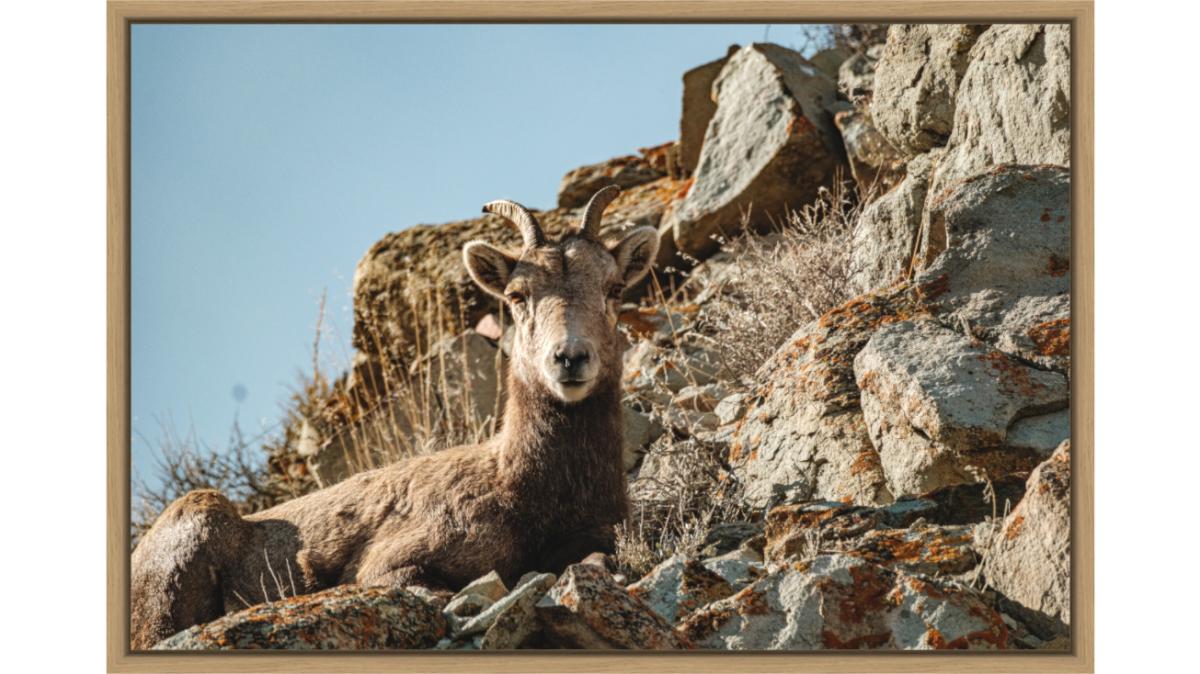
Our own catalog covers this ground directly. The Osprey in the wild print starts at $22.99 and captures the bird perched on a post, a composition that reads well in a narrow vertical space. The Bobcat in the snow at $17.99 uses a high-contrast winter background that makes the animal pop against light walls.
For a statement piece, the bighorn series runs from a $31.99 Bighorn Ram in a field up to a $289.99 large-format Bighorn Sheep resting on a rocky ledge. Each product page shows the image on a wall in multiple sizes, which solves the most common buyer question: what size actually fits my living room?

Lighting, Placement, and Archival Care for Long-Lasting Prints
Direct sunlight destroys prints faster than anything else. Ultraviolet light breaks down pigment, and a print that faces a south window unfiltered can visibly shift within two years. Hang wildlife prints on walls that receive indirect or diffused light, or add UV-filtering glass if the spot is unavoidable.
Placement follows the same logic as any wall art: center the image at eye level, roughly 57 to 60 inches from the floor to the middle of the piece. Above a sofa, leave 6 to 10 inches between the frame bottom and the furniture back. In a hallway, hang at consistent heights across the run rather than staggering.
Care is simple. Dust with a dry microfiber cloth. Never spray cleaner directly on the surface. For canvas, a soft brush removes debris from the texture without pressing it in.
Authenticity, Conservation, and the Story Behind Each Print
Authenticity certification protects both the buyer and the photographer. A Certificate of Authenticity (COA) is a signed document that travels with the print and establishes what you actually own. For a limited edition, it should name the photographer, the image title, the edition size, the specific print number, the medium and dimensions, and the date of printing. For an open edition, it should still confirm the photographer and the image title so the work is traceable to its source.
Buyers who want proof they are purchasing original work rather than resold stock images should ask for documentation before checkout, not after.
Why Environmental Impact Is Now Part of the Value
A growing share of wildlife print buyers care about what the purchase supports, and and that concern is reshaping how responsible sellers produce.
Conservation is the other half of the story. The collaborative Prints for Wildlife fundraiser, which involved over 380 photographers, has raised more than $2.5 million for nature conservation since 2020, according to Prints for Wildlife's fundraising record. Meanwhile, the 2026 Wildlife Photographer of the Year competition drew a record 65,403 submissions, reported by Forbes coverage of the competition, which shows how much serious wildlife imagery is entering the market.
That volume cuts both ways. More supply means more choice, but it also means more prints produced without any connection to the animal or habitat. Ask where the photograph was taken. The answer tells you whether you are buying a document of a real encounter or a decorative image.
Frequently Asked Questions
What defines museum-quality wildlife photography prints?
Museum-grade prints use archival-quality inks and papers rated to resist fading for decades, plus high-resolution digital capture that holds detail in large format. Premium wildlife photography prints online should state the paper or medium, the ink type, and whether the print is gallery-wrapped or mounted. Look for pigment-based inks on cotton rag paper or metal, and check that the photographer offers sizing guidance so the piece suits your wall rather than just the screen.
How do I choose the right paper finish for wildlife photography prints?
Matte and cotton rag papers suit detailed feathers and fur because they cut glare and hold deep blacks, while metal prints push vibrant colors and contrast for a modern look. Canvas adds texture and works well in casual living spaces. Ask how the print will be lit before deciding. A south-facing wall with direct sun favors matte; a hallway with soft light can handle glossy or metal without distracting reflections.
Are limited edition wildlife art prints a good investment?
Most buyers purchase for the image itself rather than resale. The 2026 Wildlife Photographer of the Year competition drew 65,403 submissions, so standing out requires more than a nice frame. Buy what you want to live with, and treat any appreciation as a bonus.
How should I care for premium photography prints to prevent fading?
Keep prints out of direct sunlight and away from heat sources like fireplaces and radiators. UV-filtering glass or acrylic adds protection for framed pieces, and archival mounting boards prevent rippling over time. Humidity swings cause more damage than most people expect, so avoid bathrooms and unfinished basements. Dust with a dry microfiber cloth rather than sprays. Done well, archival-quality prints can stay vivid for decades.
What is the difference between giclée and standard photo prints?
Fine art printing using pigment-based inks on archival paper produces a wider color range and far better fade resistance than standard dye-based photo prints. Standard lab prints are cheaper and fine for casual display, but they degrade faster under light. If you are buying premium wildlife photography prints online for a statement wall, ask specifically about the printing process and what the rated display life is.
The hardest part of buying premium wildlife photography prints online is not finding a beautiful image. It is knowing whether the print will still look right in five years, in the room you actually have. Bob Clark Photography solves that by showing every image on a wall in multiple sizes before you order, offering framed and unframed options, and letting you buy the same photograph as a print or on apparel. Check out the collection and bring a piece of the Rocky Mountain west into your home.