
Mickey Shannon Alternative for Rocky Mountain Art
Table of Contents
- Why Collectors Look Beyond a Single Artist
- How to Choose Landscape Art for Your Home
- Fine Art Photography Prints for Sale: What Sets Them Apart
- Tips for Displaying Large Scale Landscape Photography
- Rocky Mountain Art That Fits Different Budgets
- What to Look For in Any Rocky Mountain Art Alternative
- Conclusion
- Frequently Asked Questions
Last Updated: September 14, 2026
Why Collectors Look Beyond a Single Artist
Search for Rocky Mountain art and you land in a walled garden: most results lead to one photographer's portfolio, useful if you already know that style, frustrating if you want the wider market. This guide from Bob Clark Photography treats the category as a collector should: choices about style, print quality, and scale, not a single default name.

The landscape photography market has shifted noticeably toward large-format, museum-quality prints made for home and gallery display. Galleries report that photographers are increasingly producing limited edition fine art nature photography to meet collector demand for pieces that hold value and presence on a wall (Carriage Factory Art Gallery exhibition coverage).
That shift changes what "alternative" means. A decade ago, a different artist meant a different eye. Today it also means a different print process, edition size, and price structure. Below, we break down how to evaluate Rocky Mountain art on its own merits, whether you are furnishing a living room or starting a collection.
How to Choose Landscape Art for Your Home
Choosing landscape art starts with two decisions in the right order: where the piece will hang, then how it will be printed. Most buyers reverse this, fall in love with an image, then discover it does not suit the room.
Matching Style and Scale to the Room
Scale is the most common mistake. A print that looks commanding on a laptop can read as a postage stamp above a sofa, and a piece that suits a narrow hallway will overwhelm a small bedroom.
A practical approach:
- Measure the wall, then target art that fills roughly two-thirds to three-quarters of the available width above a piece of furniture.
- For a sofa, aim for a piece at least half the sofa's width, or a grouping of two to three smaller prints.
- Leave at least 20 to 25 centimeters of breathing room between the art and the furniture below it.
- Match the print's orientation to the wall: panoramic mountain photography suits wide, low walls; vertical compositions suit narrow alcoves and stairwells.
Style matters just as much. High-dynamic-range images with saturated skies feel bold and dramatic; softer, misty compositions in muted tones read as calm and recede into a room. Neither is better, the question is which one your space is asking for.
Print Specs That Decide Longevity
Print specification is where cheap art reveals itself within a few years. Two things determine whether a print still looks right a decade from now: the ink and the substrate.
Giclee printing uses pigment-based inks sprayed onto archival media, producing wide color accuracy and fine detail. Pigment inks resist fading far better than the dye-based inks in mass-market posters (wilhelm-research.com).
Archival paper is a cotton-rag or alpha-cellulose stock with a neutral pH, made to resist the yellowing and brittleness of acidic paper. Gallery-wrapped canvas stretches the print around a wooden frame, so the image continues around the edges and needs no glass.
Fine Art Photography Prints for Sale: What Sets Them Apart
Fine art photography prints for sale differ from poster-shop prints in three measurable ways: edition size, materials, and the photographer's direct involvement in production. Those factors drive nearly all of the price difference across the market.
Limited Editions, Giclee Canvas, and Archival Paper
Here is how the main print formats compare on the factors that matter most to a buyer:
| Format | Typical Material | Longevity | Best For |
|---|---|---|---|
| Giclee on archival paper | Cotton rag, pigment ink | Decades with UV glass | Detailed, high-resolution images |
| Gallery-wrapped canvas | Stretched canvas, pigment ink | Long, no glass needed | Large statement pieces |
| Framed paper print | Archival paper, mat, frame | Decades | Traditional interiors |
| Unframed paper print | Archival paper | Decades, if stored flat | Renters, custom framing |
The practical takeaway: if you want a piece that arrives ready to hang and reads as substantial, canvas is the simpler path. If you want maximum detail and are willing to frame it properly, archival paper wins.
Tips for Displaying Large Scale Landscape Photography
Displaying large scale landscape photography well comes down to height, lighting, and protection. Get those three right and even an inexpensive piece looks considered. But the decision starts earlier, with the print process, because the process determines how the piece behaves on the wall over time.
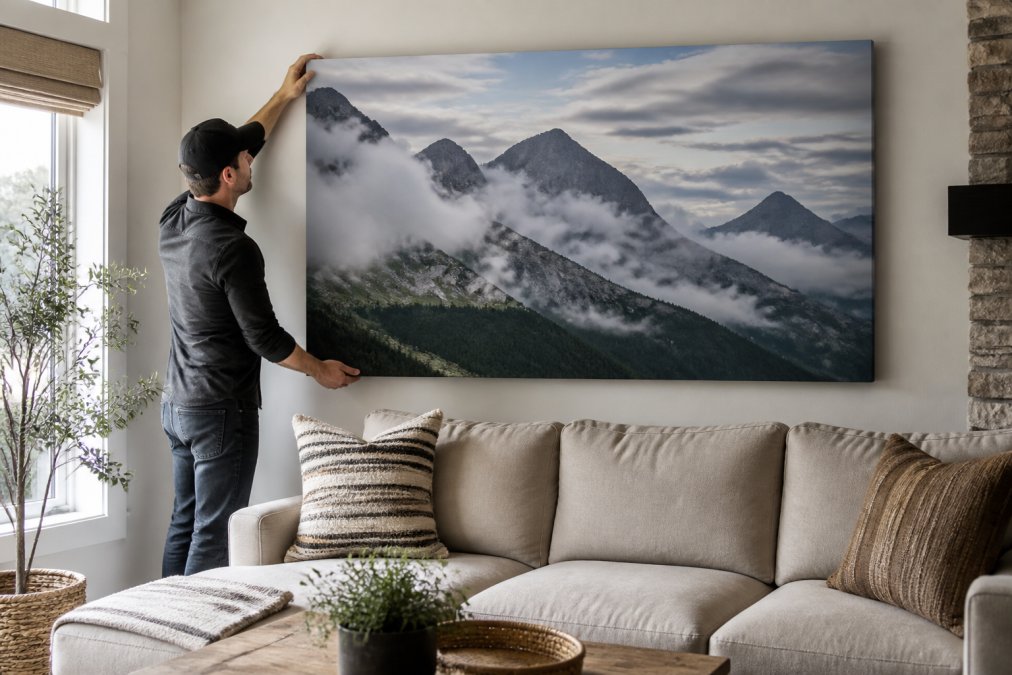
Match the Print Process to the Wall
Three print processes dominate Rocky Mountain fine art photography, and each one displays differently.
Giclee (pigment ink on archival media). Pigment inks sprayed at high resolution onto cotton-rag or alpha-cellulose paper resist fading far better than mass-market dye inks, and hold fine detail in shadows and highlights that dye-sublimation compresses. Giclee paper prints need glass, so glare management becomes part of your display plan.
Dye-sublimation on metal. Heat transfers dye into a coated aluminum panel, producing a glossy, saturated surface with no glass or frame. Metal prints read as contemporary and handle humid rooms better than paper, but the high-gloss finish can mirror a window or lamp, so placement matters more than with matte paper.
Gallery-wrapped canvas. Canvas stretches around a wooden frame so the image continues around the edges and needs no glass. It is the most forgiving format for large walls because it absorbs rather than reflects light, but the woven surface softens the finest detail compared to a giclee paper print.
The practical rule: choose the process for the room, not the other way around. A bright, glass-heavy room favors canvas or a matte paper print behind UV glass. A dim, moody room can carry a glossy metal print without glare problems.
Height, Lighting, and Protection
Hang art so the center of the piece sits at roughly eye level, which for most people means 145 to 155 centimeters from the floor. Above furniture, the bottom edge should sit 20 to 25 centimeters above the sofa or console.
Lighting deserves more attention than it gets. Direct sunlight is the enemy of any print, pigment or dye (nps.gov). Place large pieces on walls with indirect or diffused light, and use picture lights or adjustable spots that wash the surface evenly rather than creating a hot spot.
For renters, damage-free hanging strips and lightweight unframed prints solve most of the problem, and a large unframed print leaned on a console or shelf reads as intentional rather than temporary. If you are not ready for a framed statement piece, start unframed and frame it later.
Rocky Mountain Art That Fits Different Budgets
Budget determines format, not quality of eye. You can build a strong collection of Rocky Mountain art at several price points, and the differences between tiers are mostly size, framing, and edition scarcity. Here is how to read the price-to-value math underneath those tiers.
What Actually Drives the Price
Four variables explain nearly all of the spread between a $30 print and a $400 print:
- Size. A large-format print uses more substrate, ink, and careful handling. Doubling the long edge roughly quadruples surface area, and material cost scales with it.
- Substrate. Archival cotton-rag paper and gallery-wrapped canvas cost more than poster stock; metal panels cost more still because dye-sublimation requires a coated aluminum sheet.
- Edition size. A limited edition of 25 carries a scarcity premium an open edition does not.
- Framing. A framed and matted paper print adds glass, mat board, and labor. An unframed print ships flat and lets you control framing spend later.
When you compare two Rocky Mountain prints at the same size, the price gap almost always traces back to substrate, not to the image itself.
Reading the Tiers
Entry level (roughly $25 to $75). Small and mid-size unframed prints let you test a photographer's style before committing to a large piece. Bob Clark Photography's Grand Tetons print, a view of the range in Wyoming, and The Tetons, captured on a misty morning, both start at $29.99 as WhiteWall app products. Expect paper or lightweight canvas, the value is living with an image before deciding whether you want it larger.

Mid tier (roughly $75 to $250). Framed or larger-format prints live here, where the piece anchors a room rather than accenting it. Buyers at this tier pay for size and framing.
Top tier (roughly $250 and up). Large-format statement pieces carry the highest prices because of size, materials, and edition limits. Bob Clark Photography's Spectacular view of the Tetons, a view approaching Grand Teton on a misty morning, is priced at $379.00. These are the pieces buyers plan a room around.
The Price-to-Value Test
A simple way to think about value: divide the price by the number of years you expect to keep the piece on your wall. A large print you keep for fifteen years costs less per year than a poster you replace every two. Run that math before you compare two prints at different prices, because the cheaper piece is not always the better value once you account for how long it lasts.
What to Look For in Any Rocky Mountain Art Alternative
Evaluating a Rocky Mountain art alternative means checking five things in order: authenticity, print specification, edition size, scale options, and return policy. Skip any and you are guessing.
Authenticity comes first. Confirm the work is the photographer's own capture, not licensed stock. A working photographer has a portfolio, a body of work across seasons, and a consistent artistic vision, depth stock resellers rarely show.
Print specification is next. Ask about ink type, paper or canvas stock, and whether framing uses UV-filtering glass and acid-free matting.
Edition size tells you how scarce the piece is. Open editions are fine for decoration. Limited editions matter if you care about value.
Scale options matter because a photographer who only offers one size cannot solve a specific wall. Look for a range from small unframed prints to large-format pieces.
Return policy protects you against the gap between screen and wall. Color accuracy varies between monitors, and a print can look different in your lighting than on your laptop. A clear exchange or return window removes most of the risk from buying art online.
Conclusion
The hard part of buying Rocky Mountain art is not finding an image you like. It is finding a photographer whose print process, edition sizes, and scale options actually match how you plan to live with the work. Most buyers only discover that mismatch after the piece is on the wall.
Bob Clark Photography approaches that problem directly. The collection covers landscape and wildlife photography from across the Rocky Mountain west, including California, Montana, and Idaho, and every image is available as a professional print, framed or unframed, with apparel and accessories for collectors who want the work beyond the wall. If you are weighing a Mickey Shannon alternative for Rocky Mountain art, start with the print specification and the edition size, then let the image decide.
Check out the Bob Clark Photography collection and find the piece that fits your wall.
Frequently Asked Questions
What should I look for when buying fine art landscape photography?
Check three things: the print medium, the edition size, and color accuracy. Ask whether the photographer uses high-resolution digital capture and post-processing techniques that preserve lighting and texture. Bob Clark Photography's Tetons prints, for example, start at $29.99 for smaller sizes, so you can test the quality before committing to a larger piece.
How do I choose the right size photography print for my wall?
Measure the wall space first, then aim for a print that fills 60 to 75 percent of the available width above a sofa, bed, or console. For a typical living room wall, a 30x40 inch or larger panoramic mountain photography print works well. If you rent or want flexibility, unframed prints let you swap sizes without new hardware. Order a smaller version first to check color and composition in your actual lighting.
How does professional landscape photography differ from stock images?
Stock images are licensed for broad commercial use and often appear across many products and websites. Professional fine art prints are captured, edited, and printed by the photographer as a finished artwork. That means you get original artistic vision, and a print rather than a mass-produced file. Buying directly from a landscape photographer also means your purchase supports the person who made the image.
Are there different printing mediums for landscape art?
Yes. The most common are canvas, archival paper, and metal or acrylic mounts. Each medium affects print longevity and how lighting and texture read in a room, so match the medium to your wall and lighting conditions.
What are the benefits of buying directly from a landscape photographer?
You get authenticity, direct communication, and often better control over print finishing. When you buy from an individual photographer rather than a marketplace, you can ask about paper stock and custom sizes. Bob Clark Photography, for instance, offers a curated selection of Rocky Mountain art as prints, framed art, and apparel, all from original photographs. Direct purchases also mean faster help if a framed piece arrives damaged.