
Identifying High Quality Photography Print Paper: A Guide
Table of Contents
- Photography Paper Weight GSM Explained: Why 300+ Matters
- Glossy, Matte, or Lustre: Matching Finish to Your Image
- Choosing Between Cotton Rag and Alpha Cellulose Paper
- Archival Fine Art Paper Standards: What to Look For
- How to Spot Quality: Surface, Brighteners, and Dmax
- A Practical Framework for Identifying High Quality Photography Print Paper
- The Bottom Line on Print Paper Quality
- Frequently Asked Questions
Last Updated: September 7, 2026
The global photo paper market is valued at USD 1.67 billion in 2026, yet most photographers still struggle to tell a premium substrate from a budget option Business Research Insights 2026 market report. Identifying high quality photography print paper comes down to a handful of physical properties you can verify before you buy, not the brand name on the box. Identifying high quality photography print paper comes down to a handful of physical properties you can verify before you buy, not the brand name on the box. The same criteria apply whether you are printing a 40-inch Rocky Mountain panorama or a small gift print. This guide walks through the weight, finish, and base material decisions that separate archival-grade work from prints that fade or curl within a few years.
The broader photo printing market is projected to grow at a 4.33% CAGR through 2031, driven partly by renewed interest in tangible, long-lasting prints Mordor Intelligence photo printing market analysis. Below, we will show you how to evaluate paper like a professional printmaker, covering the five specifications that matter most.
Photography Paper Weight GSM Explained: Why 300+ Matters
Paper weight is the first filter for identifying high quality photography print paper. The industry standard for archival-grade fine art prints is 300+ GSM (grams per square meter), a threshold that indicates sufficient density for longevity and professional exhibition standards Kate Backdrop photo paper guide. For most high-quality photography paper, the ideal range sits between 180 and 330 GSM, with weights below that feeling flimsy and prone to curling under pigment ink saturation.
| Paper Weight | Best Use | Longevity Profile |
|---|---|---|
| 180-250 GSM | Proofing, portfolio prints | Good for short-term display |
| 250-300 GSM | Standard gallery prints | Strong balance of handling and cost |
| 300+ GSM | Archival fine art, exhibitions | Optimal for longevity and framing |
Thickness matters too. A benchmark of 10.3 mils is cited as standard for professional-grade paper, giving the print a substantial feel that signals quality before you even examine the image Kate Backdrop physical specifications guide.
Glossy, Matte, or Lustre: Matching Finish to Your Image
Finish determines how light interacts with your print, and choosing wrong can undermine even the best image. But the decision goes beyond a simple aesthetic preference, it involves measurable trade-offs in dynamic range, surface reflectivity, and even how the print behaves under glass.
Glossy papers deliver the widest color gamut and the highest dmax (maximum density), often exceeding 2.0 in contrast ratio, which produces the deepest blacks and most saturated colors. This makes them the default for vibrant wildlife, macro, and commercial work where punch is paramount. However, glossy surfaces are specular, they reflect light directionally, meaning any glare from a window or overhead light creates a hot spot that obscures the image. Under glass, glossy prints are also prone to Newton's rings, a phenomenon where the print surface and glass touch at microscopic points, creating iridescent halos. To avoid this, you must use a mat or a frame with a gap between the print and the glazing.
Matte papers diffuse light across their textured surface, eliminating specular glare entirely. This makes them the preferred choice for low-light gallery settings or rooms with uncontrolled, bright ambient light. The trade-off is a lower dmax, typically 1.6 to 1.8, because the textured surface scatters light within the shadow areas, reducing perceived depth. Matte finishes also absorb more ink, which can lead to a slight loss of sharpness on fine details unless you compensate with a sharper capture or a higher-resolution print. For moody landscapes with large shadow areas, the even, glare-free appearance of matte often outweighs the loss of dmax.
Lustre and satin finishes occupy the middle ground. They have a subtle, pebbled texture that reduces fingerprints and glare while retaining a contrast ratio close to glossy, often 1.9 or higher. This makes lustre the most forgiving finish for handling and the most versatile for mixed-use portfolios. The texture, however, can interfere with very fine detail in skies or skin tones, producing a faint graininess that some photographers find objectionable at close viewing distances.
A unique consideration that most guides ignore is how the finish interacts with framing glass. Anti-reflective (AR) glass, which is common in professional framing, reduces glare but can also diffuse the micro-texture of a matte or lustre surface, making it appear flatter. Conversely, standard clear glass preserves the surface texture but introduces reflections. If you are framing a glossy print, use AR glass with a mat to prevent Newton's rings. If you are framing a matte print, standard clear glass is often sufficient, as the paper's diffusion already handles glare.
For landscape work, consider the lighting where the print will hang. A glossy finish in a bright, window-heavy room creates distracting reflections. A matte or lustre finish performs better in those conditions, preserving detail in shadow areas without glare. The final decision should be a deliberate trade-off between dmax, surface texture, and the physical environment of the display space.
Choosing Between Cotton Rag and Alpha Cellulose Paper
The base material of your photography print paper determines its longevity and tactile character. Cotton rag paper, made from 100% cotton fibers, is the gold standard for archival fine art paper standards because cotton is naturally acid-free and lignin-free, resisting yellowing and degradation over decades. Alpha-cellulose paper, derived from wood pulp that has been purified to remove lignin, offers a more affordable alternative with good longevity when properly processed.
For museum-quality work intended to last generations, cotton rag is the safer investment. It also has a distinct, soft texture that many photographers prefer for fine art landscape prints. Alpha-cellulose papers are thinner and smoother, which can actually benefit highly detailed images where you want maximum sharpness without surface texture interfering.
Archival Fine Art Paper Standards: What to Look For
Archival quality is not a marketing term; it refers to measurable properties that predict print permanence. Look for papers labeled acid-free and lignin-free, which resist chemical breakdown over time. The substrate should also be buffered with calcium carbonate to neutralize environmental acids that cause yellowing.
Industry research has documented manufacturer-applied markings on paper backs that assist in authentication and dating of photographic prints, a practice cataloged across 5,000+ samples The Classic Photo Mag research on photographic papers. While you do not need to date your paper, checking for manufacturer markings and batch codes confirms you are buying genuine product from a reputable mill, not a counterfeit or mislabeled substrate.
Print permanence also depends on your ink choice. Pigment inks sit on the paper surface and resist UV fading far better than dye inks, which absorb into the fibers and break down faster. Pairing pigment inks with a microporous, cotton-based paper is the standard recipe for archival prints.
How to Spot Quality: Surface, Brighteners, and Dmax
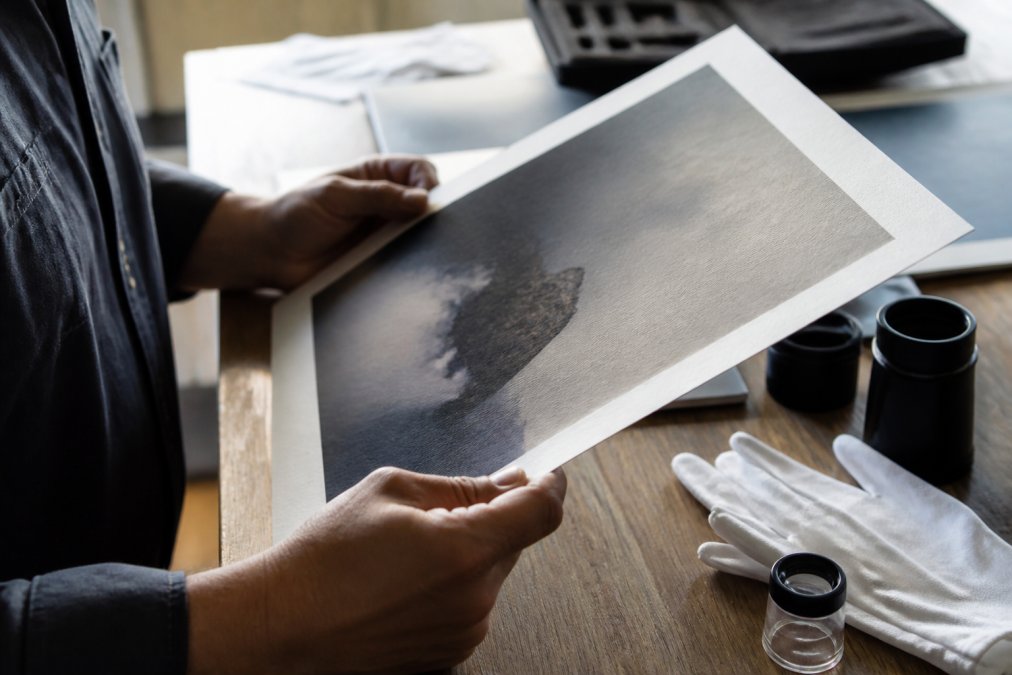
Visual inspection reveals a lot about photography print paper quality. Examine the surface under raking light: a premium paper should show a consistent, even texture without streaks or blotches. Run your fingers across the surface; cotton rag feels soft and slightly fibrous, while alpha-cellulose feels smoother and more uniform.
Optical brighteners (OBAs) are a hidden variable. Many papers contain OBAs to make the white point appear brighter, but these compounds degrade with UV exposure, causing prints to yellow or shift color over time. Archival-grade papers increasingly use OBA-free formulations, accepting a slightly warmer white point in exchange for stability. When comparing papers side by side, hold them under a UV light source; OBA-laden papers will fluoresce visibly.
Dmax, or maximum density, measures how dark a paper can render black. Higher contrast ratio is a key indicator of quality because it allows for deeper blacks and brighter whites Red River Paper quality indicators. You can test this by printing a grayscale step wedge and examining the shadow steps: a paper with strong dmax will maintain detail in the darkest tones without them turning muddy or gray.
A Practical Framework for Identifying High Quality Photography Print Paper
When you evaluate a paper for your own prints, work through a consistent checklist rather than relying on brand reputation. Research comparing premium papers has found that brand selection impacts color reproduction and cost-efficiency, but the most expensive option is not always the best for every image Cuchara Photography fine art paper comparison. Some photographers find that less expensive brands deliver results comparable to premium alternatives for certain applications.
Use this five-point evaluation framework:
- Check the spec sheet for GSM (300+ for archival), caliper (10+ mils), and acid-free certification
- Test the surface texture by touch and under raking light for consistency
- Verify OBA content with a UV light source to predict long-term color stability
- Print a test file with a grayscale step wedge and saturated color blocks to assess dmax and gamut
- Compare against a known reference paper you have printed before to judge relative quality
The missing step: print-to-screen calibration. Most photographers blame the paper when a print looks 'off,' but the #1 cause of a disappointing print is an uncalibrated monitor. If your display is too bright or has a blue color cast, you will edit the image to compensate, and the resulting file will print dark or yellow on any paper, even the highest-quality substrate. Before you evaluate a new paper, calibrate your monitor with a hardware device like an X-Rite i1Display Pro or a Datacolor SpyderX. Set your display to a luminance of 80-120 cd/m² (candela per square meter) and a white point of D65 (6500K) to match standard print viewing conditions. Then, soft-proof the image in your editing software using the paper's ICC profile. This workflow isolates the paper's performance from your display's inaccuracies, allowing you to judge the substrate fairly.
A decision matrix for paper selection. Instead of a generic checklist, use a decision matrix that maps your image's characteristics to the paper's properties. For each candidate paper, score it on a scale of 1-5 for the following criteria:
- dmax (shadow depth): Critical for high-contrast images with large black areas.
- Surface texture (smoothness vs. tooth): Important for fine detail; smooth surfaces preserve sharpness, while textured surfaces add a painterly feel.
- OBA content (0 = none, 5 = high): High OBA papers look brighter initially but may yellow over time; low-OBA papers are more stable.
- Gamut (color vibrancy): Essential for saturated wildlife or commercial work.
- Handling (curl resistance, ink absorption): Matters for printing in humid environments or with high ink loads.
For a moody forest scene with deep shadows, prioritize dmax and low OBA. For a bright, airy coastal image, prioritize gamut and a smooth surface. This matrix forces you to make deliberate trade-offs rather than defaulting to a single 'best' paper.
For photographers printing at home, proper paper storage is an overlooked factor. Store paper flat, sealed in its original packaging, away from humidity and direct sunlight. High-GSM cotton papers can absorb moisture from the air, causing curl and feeding problems in your printer. A consistent environment at 40-50% relative humidity keeps the substrate stable. Additionally, always let a freshly printed sheet dry flat for at least 24 hours before framing; the ink solvents need time to off-gas, and premature framing can trap moisture and cause the paper to buckle.
The Bottom Line on Print Paper Quality
Identifying high quality photography print paper requires checking weight, finish, base material, and archival properties rather than trusting a premium brand name. A 300+ GSM cotton rag paper with an OBA-free formulation and pigment ink pairing will outperform a cheaper alternative in both visual impact and longevity.
For landscape and wildlife prints meant to be framed and displayed for years, the substrate is as important as the image itself. For landscape and wildlife prints meant to be framed and displayed for years, the substrate is as important as the image itself. The tactile quality of a fine art print, its weight in your hands, and its stability on your wall are all determined by choices made before the ink touches the paper. The tactile quality of a fine art print, its weight in your hands, and its stability on your wall are all determined by choices made before the ink touches the paper.
Frequently Asked Questions
What type of photo paper do professional photographers use for gallery prints?
For gallery and museum exhibitions, most professionals choose 300+ GSM cotton rag papers. These heavyweight, acid-free substrates offer the archival stability and texture that collectors expect. Brands like Canson Infinity and Hahnemühle are common, but the specific choice depends on the image. A landscape with fine detail may suit a smooth rag, while a textured watercolor-style paper adds a painterly feel to softer work.
What does 'archival quality' mean when selecting photography paper?
Archival quality means the paper and inks are designed to resist fading, yellowing, and degradation for decades. Key markers include acid-free and lignin-free bases, which prevent the paper from breaking down over time. Look for a weight of 300+ GSM and pair it with pigment inks, which are more stable than dye inks. These standards ensure your print maintains its color accuracy and tonal range for generations.
Is matte or glossy paper better for high-end landscape photography?
Neither is universally better; the right choice depends on the image and lighting. Glossy paper offers the widest color gamut and highest dmax, producing deep blacks and vivid saturation, ideal for high-contrast, colorful scenes. Matte paper has a reflective-free surface that suits low-light viewing and fine detail, but its blacks are less deep. For landscapes, many professionals favor a lustre or satin finish as a middle ground between the two.
How do I identify acid-free and lignin-free photography paper?
Acid-free and lignin-free certifications are usually printed on the packaging or listed in the paper's technical specifications. These terms indicate the paper base has been processed to remove acids and lignin, compounds that cause yellowing and brittleness over time. Alpha-cellulose and cotton rag papers are naturally more stable in this regard. If you are buying from a print shop, ask to see the paper's spec sheet to confirm these details.
What is the difference between resin-coated and fiber-based photo paper?
Resin-coated (RC) paper has a polyethylene layer on both sides of the base, making it water-resistant and fast-drying. It is common for consumer prints and proofing because it is durable and inexpensive. Fiber-based (FB) paper, often made of cotton rag or alpha-cellulose, is more traditional and absorbs ink into the base for a wider tonal range and superior archival longevity. FB paper requires more careful handling and longer drying times.
Does the brand of paper affect the quality of the final print?
Yes, but not in the way you might expect. Brand selection impacts color reproduction and cost-efficiency, as each manufacturer uses unique coatings and base formulations. However, a less expensive brand can produce results comparable to premium fine art papers for certain images. The best approach is to test papers from a few reputable manufacturers, like Canson, Canon, and Red River, to find the one that best matches your specific images and workflow.
Choosing the right paper is the difference between a print that fades and one that becomes a lasting piece of art. Check out the print options at Bob Clark Photography to see archival-grade landscape and wildlife photography on substrates built to endure. Every print reflects the Rocky Mountain west in faithful color and detail, crafted to look as good on your wall as it does on screen.