
How to Gift Photography Prints: A Complete Guide
Table of Contents
- Step 1: Choose the Right Photography Print for the Recipient
- Step 2: Select the Best Framing Options for Photography Prints
- Step 3: Master Photography Print Gift Wrapping Ideas
- Step 4: Present the Gift with Context and a Personal Touch
- Step 5: Understand How to Return Photography Art Gifts
- Budget-Friendly DIY vs. Professional Printing Services
- Frequently Asked Questions
Last Updated: September 19, 2026
Step 1: Choose the Right Photography Print for the Recipient
The best gift photography prints start with the person, not the picture. The global photo printing and merchandise market hit $26.4 billion in 2026, and photo prints alone make up 27.3% of that spending, according to Future Market Insights' photo printing market report. Individual consumers drive 47.9% of that demand, and gifting is one of the top reasons they buy.
That means your choice matters more than your budget.
Matching the Image to Their Interests and Space
Start with a memory or a place, not a color scheme. A sister who grew up near Glacier National Park will light up at a Montana landscape. A friend who proposed in Yosemite wants Half Dome, not a generic mountain scene.

Then check the wall.
- Large open walls: go bigger, 16x20 or larger
- Rental apartments: stick to 8x10 or smaller
- Office desks: 5x7 works best
- Gallery walls: mix three to five small prints
Step 2: Select the Best Framing Options for Photography Prints
Framing is where most gift-givers overspend or underdeliver. The right choice depends on the recipient's home, not the price tag, and on whether the print is meant to be a temporary decoration or a keepsake that outlives the wrapping paper.
| Option | Best For | Cost Range | Risk |
|---|---|---|---|
| Unframed print | Renters, DIY types | Lowest | Needs a frame later |
| Standard frame | Most gifts | Mid | Style mismatch |
| Canvas wrap | Modern homes | Mid-high | Hard to move |
| Museum frame | Statement pieces | Highest | Heavy, permanent |
Framed vs. Unframed Prints: Which Works Better as a Gift?
Framed prints win for housewarmings and milestone gifts. They're ready to hang the moment they're unwrapped.
What Actually Determines Whether a Framed Print Lasts
The frame is not the point. The materials inside it are. Three components do the real work:
- Mat board. Standard mat board is buffered with calcium carbonate to neutralize acid, but only the surface layer is typically buffered. A true conservation mat is 100% cotton rag or alpha-cellulose, lignin-free, and buffered throughout. Lignin is the culprit, it's the natural polymer in wood pulp that breaks down into acidic compounds and yellows paper over time. If the mat isn't labeled "acid-free" or "conservation grade," assume it isn't.
- Glazing. Acrylic (often sold as Plexiglas or Optium) is lighter and shatter-resistant, which matters for shipping and for homes with kids or pets. Glass is heavier and more scratch-resistant but can break in transit. For UV protection, look for glazing rated to block 97-99% of UV radiation. Uncoated glass blocks almost none. UV light is the single biggest cause of fading in color photographs, and it acts cumulatively, a print in a bright room fades faster than the same print in a hallway.
- Backing and mounting. A rigid acid-free backing board keeps the print from sagging. Dry mounting (heat-activated adhesive) flattens a print permanently but is irreversible, never dry-mount a print you might want to remove later. Hinge mounting with acid-free linen tape is reversible and is the standard for anything with resale or sentimental value.
Hanging Hardware and the Weight Problem
A 16x20 framed print with glass can weigh 5-8 pounds. A 24x36 with a wide mat and glass can exceed 15 pounds. Most picture-hanging hooks sold at hardware stores are rated for 5-10 pounds and fail silently, the hook holds, the drywall gives. For anything larger than 16x20, use two hooks spaced a few inches apart so the wire forms a shallow V, or install a French cleat rated for twice the frame's weight.
The Archival Question You Should Ask Before You Buy
If the print is a keepsake, a wedding photo, a landscape from a trip that mattered, ask the seller two questions before checkout:
- Is the paper acid-free and lignin-free?
- Is the ink pigment-based or dye-based?
Step 3: Master Photography Print Gift Wrapping Ideas
Good photography print gift wrapping ideas do one thing: protect the print and build anticipation. Skip the fancy ribbon if it means a bent corner.
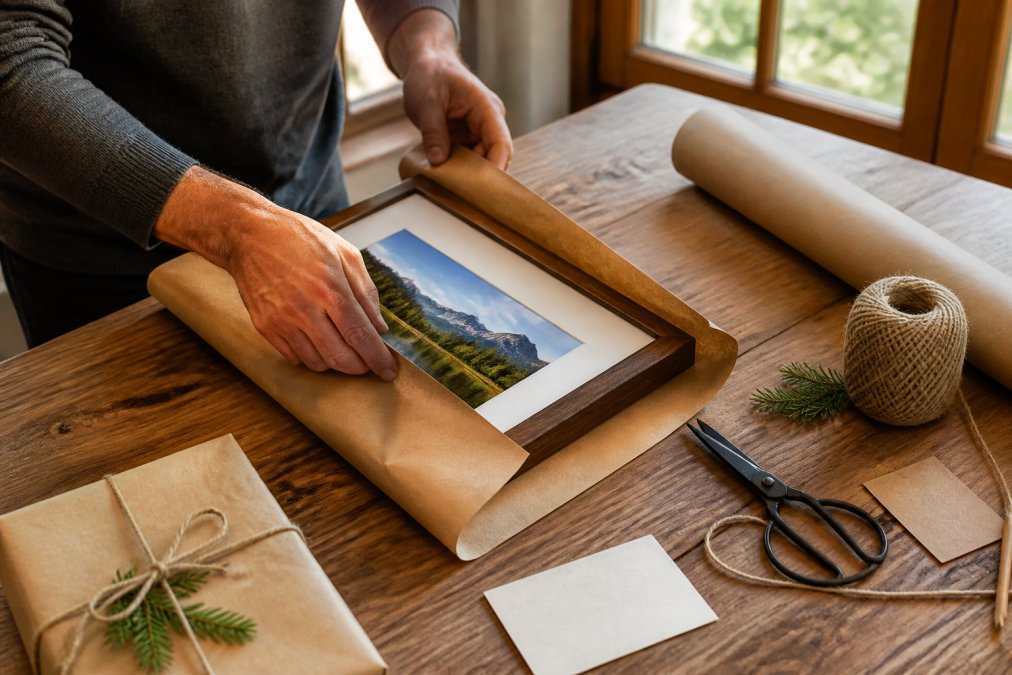
Try these:
- Roll unframed prints in acid-free tissue, then a rigid tube
- Use kraft paper and twine for a simple, natural look
- Tuck a handwritten note about the location inside
- Add a small map pin marking where the photo was taken
Step 4: Present the Gift with Context and a Personal Touch
Presentation turns a print into a keepsake. The image already carries meaning. Your job is to name it.
Write a short card that answers three things:
- Where the photo was taken
- Why you picked it for them
- What you hope it reminds them of
Step 5: Understand How to Return Photography Art Gifts
Returns on art feel awkward, but they're normal. Knowing how to return photography art gifts before you buy saves everyone stress.
- Return window: usually 14-30 days
- Condition rules: unframed prints often must be unopened
- Custom items: framed or personalized pieces may be final sale
- Shipping cost: who pays the return label
- Exchanges: can you swap the image instead of refunding
Budget-Friendly DIY vs. Professional Printing Services
The DIY route costs less up front. Professional printing costs less over time. But the decision isn't really about money, it's about whether the file you're sending will survive the trip from your screen to paper. That's the step almost every gift guide skips, and it's the one that determines whether the print looks like the photo you fell in love with.
The Digital-to-Physical Workflow Nobody Explains
A photograph on a monitor is backlit. A print is reflected light. That single difference is why prints often look darker, flatter, or more saturated than the screen version. Three things control the gap:
- Resolution. For a print viewed at arm's length, 300 pixels per inch (ppi) at the final print size is the standard target. An 8x10 needs roughly 2400 x 3000 pixels. A 16x20 needs roughly 4800 x 6000. Below 200 ppi, edges soften and fine detail, grass, hair, distant tree lines, turns to mush. Most phone cameras from the last several years can clear 300 ppi at 8x10 but not at 16x20 without upscaling.
- Color profile. Consumer screens display in sRGB. Professional labs often print in Adobe RGB or a printer-specific ICC profile, which covers a wider gamut of greens and cyans. If you send an sRGB file to a wide-gamut printer without converting, the lab's software guesses, and saturated colors can shift. Most labs publish their ICC profile for download so you can soft-proof at home before ordering.
- Sharpening and brightness. Prints need slightly more output sharpening than screen viewing, and many photographers brighten an image 5-10% before printing to compensate for the way paper absorbs light. This is a judgment call, not a rule, but it's the difference between a print that looks right on the wall and one that looks muddy.
When DIY Actually Wins
Home printing makes sense when:
- The gift is casual, a birthday print for a friend, a desk photo for a coworker
- You're printing small (4x6, 5x7) where resolution and color shifts are less visible
- You're bundling multiple prints into a mini gallery and the per-print cost matters
- The recipient will likely swap the image out within a year or two
The Click Community's DIY mounting ideas shows how hand-painted clipboard frames, driftwood hangers, and stacking rock holders turn standard prints into heartfelt decor. That's the DIY upside: personality. A $2 print on a $4 clipboard can out-charm a $200 framed piece if the story behind it lands.
When to Pay for a Lab
Go professional when:
- The print is a milestone gift, wedding, anniversary, memorial, retirement
- The final size is 11x14 or larger, where resolution and color errors become obvious
- The image has subtle tonal range (sunrise gradients, skin tones, fog) that consumer printers tend to band or posterize
- You want the print to still look right in 20 years
Here's the trade-off:
| Factor | DIY Printing | Professional Lab |
|---|---|---|
| Upfront cost | Lowest | Higher |
| Color accuracy | Varies | Calibrated |
| Longevity | Years | Decades |
| Uniqueness | High | High |
| Best for | Casual gifts | Keepsakes |
The Sustainable Angle Most Guides Miss
If the recipient cares about waste, and a growing share of buyers do, the DIY-versus-lab decision has an environmental dimension that rarely gets mentioned. Consumer inkjet cartridges are notoriously hard to recycle and often end up in landfill. Many professional labs, by contrast, print on demand (no overrun waste), use paper sourced from certified sustainable forestry, and offer plastic-free packaging on request.
Frequently Asked Questions
Should I frame a photography print before gifting it?
It depends on the recipient and the occasion. A framed print arrives ready to hang and feels more like a complete gift, which works well for birthdays or housewarmings. Unframed prints give the recipient freedom to choose their own frame and mat, which matters if you are unsure about their decor style. If you want to gift photography prints that match a specific space, consider a framed option. Otherwise, an unframed print paired with a nice frame or a gift card to a local framer gives flexibility.
How do I choose the right size photography print for a gift?
Start by thinking about where the recipient will display it. A small 8x10 print works well on a desk, shelf, or gallery wall, while larger sizes suit a living room or hallway. If you are unsure, a mid-size print in the 11x14 to 16x20 range offers versatility. Ask the recipient about their space if possible, or choose a size that fits common frame dimensions. Many photographers offer print bundles or mini galleries that let you gift several smaller prints instead of one large piece.
Are printed photos considered a thoughtful gift?
Yes, printed photos are widely regarded as thoughtful gifts, especially when they carry personal meaning. Choosing an image based on the recipient's interests or shared memories makes the gift feel intentional rather than generic.
What is the best way to wrap a large photography print?
For large prints, skip traditional wrapping paper that can crease or tear. Instead, roll the print in acid-free tissue paper, then place it in a rigid tube or a flat archival box. Add a ribbon or twine around the tube and attach a handwritten note explaining why you chose that image. If the print is already framed, wrap the frame in bubble wrap and place it in a sturdy box, then decorate the outside with kraft paper and a personal message. This protects the print and makes the unwrapping experience feel intentional.
Choosing a photography print gift comes down to one question: will this still mean something in five years? That's the standard we hold at Bob Clark Photography, where every image comes from the Rocky Mountain west and beyond, printed as framed art, unframed prints, or wearable pieces. Browse the collection, pick the landscape that matches their story, and check out with confidence.