
Best Landscape Art for Living Rooms: 2026 Guide
Table of Contents
- How to Choose the Best Landscape Art for Living Rooms
- Large Landscape Wall Art for Living Room Spaces
- Top Landscape Art Styles and Themes for Living Rooms
- Color Palette Coordination and Creating a Focal Point
- How to Hang Landscape Art Above a Sofa
- Landscape Art Styling Tips: Galleries, Groupings, and More
- Frequently Asked Questions
Last Updated: August 31, 2026
Finding the best landscape art for living rooms is harder than it looks. The wall space is usually the largest canvas in your home, and a wrong choice in scale, tone, or subject reads immediately. Landscape art depicts natural environments: mountains, seascapes, deserts, forests, and open skies. The right piece anchors the entire room's atmosphere. Below, we'll walk through exactly how to choose, size, hang, and style landscape art so your living room feels intentional.
Quick Picks:
- Best for Rocky Mountain authenticity: Bob Clark Photography prints, original fine art photography on archival cotton rag paper
- Best for curated contemporary styles: Tappan Collective, limited edition prints with an art advisory option
- Best for budget-conscious buyers: Juniper Print Shop, interior designer-curated selections starting at accessible price points
- Best for sheer selection: iCanvas, oversized canvas prints across mountains, oceans, and desert hues
How to Choose the Best Landscape Art for Living Rooms
Choosing landscape art comes down to three decisions: style match, scale, and emotional register. Get all three right and the piece feels like it was always there.
Match the Art Style to Your Room's Aesthetic
The art style should reflect or deliberately contrast the room's existing design language. A minimalist room with clean lines and neutral tones reads well with ethereal landscapes: hazy mountain silhouettes or muted coastal photography. A warmer, more eclectic room can carry richer color contrast or high-contrast photography prints.
Start by identifying your room's dominant material palette. Warm woods and leather pull toward golden-hour western landscapes. White walls with concrete or steel accents suit abstract or black-and-white photography. Biophilic design spaces, rooms already incorporating plants and natural fibers, pair naturally with nature-themed art that extends that vocabulary.
Abstract vs. Realistic Landscapes: Which Works Better?
Abstract landscapes work better in contemporary and modern rooms; realistic landscapes carry more emotional specificity and anchor traditional or nature-forward interiors.
Abstract landscape art adds visual texture without demanding the viewer recognize a specific place. Realistic landscape photography carries a sense of place and transports the viewer to a specific moment. Both work, the question is what you want the room to do. If the goal is calm and visual warmth, realistic nature photography tends to outperform abstract work. If the goal is conversation and visual dynamism, abstract landscapes earn their place.
Large Landscape Wall Art for Living Room Spaces
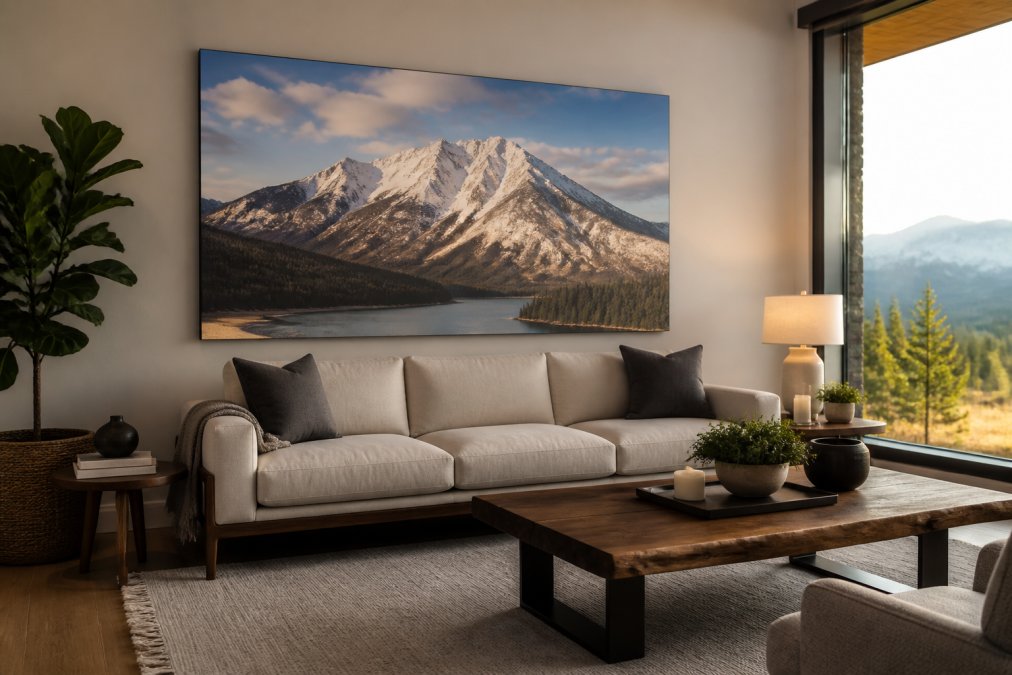
Large landscape wall art creates a statement piece that defines the room rather than decorating it. Oversized art, anything above 40 inches on the longest side, shifts from "art on a wall" to "the room's focal point."
Sizing by Room Dimensions: The Two-Thirds Rule
The two-thirds rule is the most reliable sizing guideline: the art should span roughly two-thirds the width of the furniture it hangs above. For a standard 84-inch sofa, that means art between 54 and 60 inches wide. Room dimensions also matter independently of furniture. High ceilings (10 feet or above) can carry taller art without feeling compressed. Standard 8-foot ceilings work best with horizontal panoramic formats.
| Room Size | Recommended Art Width | Format |
|---|---|---|
| Small living room (under 200 sq ft) | 24-36 inches | Single vertical or square print |
| Medium living room (200-350 sq ft) | 36-54 inches | Horizontal panoramic or diptych |
| Large living room (350+ sq ft) | 54-80+ inches | Oversized single or gallery wall |
| High-ceiling room (10+ ft) | 40-60 inches | Tall vertical or portrait format |
Canvas Prints vs. Framed Prints for Large Walls
Canvas prints wrap the image around a wooden stretcher frame, giving the art a dimensional, gallery-like presence. They're lighter than framed glass prints at large sizes and read as more casual and contemporary.
Framed prints, particularly fine art photography on archival 100% cotton rag paper, deliver sharper detail and richer tonal range. For photography-forward landscape art, archival prints preserve quality over decades in ways that standard canvas cannot match.
Top Landscape Art Styles and Themes for Living Rooms
Rocky Mountain and Western Landscapes
Rocky Mountain and western landscape photography is the most versatile category for American living rooms. The subject matter, dramatic peaks, open skies, golden meadows, carries broad emotional appeal and works across many interior styles.
What makes western landscape photography compelling is its specificity. A photograph of a specific ridge at a specific time of day carries more presence than a generic "mountain scene." Bob Clark Photography's collection delivers original fine art photography from the Rocky Mountain west, printed on archival 100% cotton rag paper and hand-checked for authenticity. Each print is available in multiple sizes, making it possible to find the right scale for your wall.
Seascapes, Botanical Illustrations, and Desert Hues
Seascapes bring a sense of movement and expansiveness. A wide-format ocean print with strong horizontal lines elongates a room visually and introduces cool blue tones that calm the atmosphere.
Botanical illustrations, whether vintage-inspired or contemporary photography, add organic texture without visual weight. They work especially well in gallery wall arrangements.
Desert hues are having a sustained moment in interior styling. Warm terracotta, sage, ochre, and sand tones in landscape photography translate directly into current color palette conversations in furniture and textile design. A desert landscape print can anchor a room's warm color story.
Color Palette Coordination and Creating a Focal Point
Color palette coordination is the step most buyers skip, and it's why so many living rooms end up with art that never quite belongs. The goal is not to match colors exactly, but to find art that shares the room's tonal family.
Warm rooms (amber, terracotta, wood tones) pair with landscape art in golden, russet, and sage palettes. Cool rooms (gray, white, blue-green) suit photography with high-contrast skies or blue-hour mountain light. Neutral rooms are most flexible but benefit most from art with a single strong color accent.
Creating a focal point means placing the piece where sight lines naturally converge, above a sofa, fireplace, or media console. Oversized art almost always achieves this automatically. For smaller prints, a gallery wall grouping can generate the same visual weight as a single large piece, provided the arrangement has clear structure and consistent framing.
According to research on biophilic design principles, incorporating nature imagery into interior spaces is associated with measurable improvements in perceived comfort and stress reduction.
How to Hang Landscape Art Above a Sofa
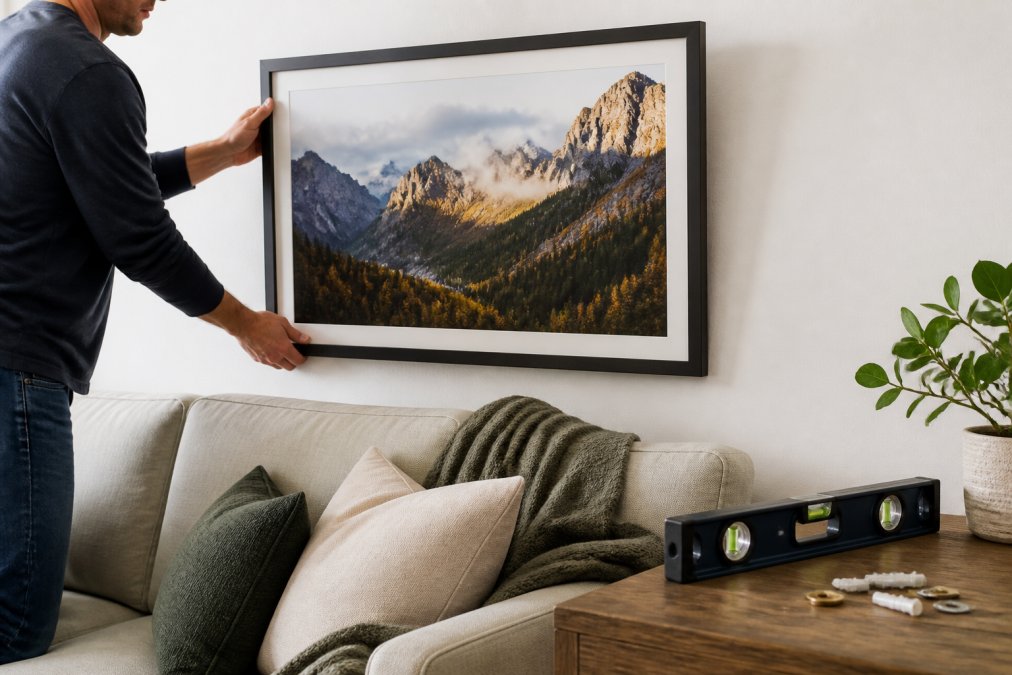
Hanging landscape art correctly means getting three things right: height, centering, and hardware. The standard guideline is to position the center of the artwork 57 to 60 inches from the floor, approximately eye level for a standing adult, which typically places the bottom of the frame 6 to 8 inches above the sofa back.
Mounting Hardware and DIY Framing Hacks
For most prints under 15 pounds, a single picture hook rated for the weight is sufficient. For heavier framed prints, use two hooks spaced evenly to distribute the load and prevent tilting.
DIY framing hacks worth knowing:
- The paper template method: Trace the frame on kraft paper, mark the hanging hardware positions, and tape the template to the wall before driving any nails.
- Removable adhesive strips (rated for the print's weight) work well for renters and hold reliably for prints under 8 pounds.
- French cleats are the professional solution for heavy framed art, distributing weight across a wider wall area.
As noted in The Smithsonian's guide to art care and display, always use proper hanging wire or D-rings on the frame rather than improvised solutions.
Lighting Considerations for Landscape Art
Lighting is the most underrated element of displaying landscape art. Natural light is most flattering for photography prints, but position prints where they receive indirect light rather than direct sun exposure to avoid UV degradation.
For artificial lighting, picture lights mounted directly to the frame provide even illumination without glare. Warm white light (around 2700-3000K) enhances the warmth and character of landscape photography; cool white light tends to flatten tonal range.
Landscape Art Styling Tips: Galleries, Groupings, and More
Gallery walls work when they have a unifying principle: consistent framing, a shared color palette, a single subject category, or a clear grid structure. For large landscape wall art in a living room, a single oversized statement piece typically outperforms a gallery wall unless the room is very wide. Gallery walls work best on walls at least 8 feet wide.
The Color Association of the United States guidelines on color in interior environments suggest that nature-themed color palettes, greens, blues, earth tones, are among the most universally accepted for shared living spaces, supporting the sustained popularity of landscape art.
The Psychological Impact of Nature Scenes
Nature scenes in interior spaces activate biophilic design principles: humans have an innate positive response to natural imagery. Seascapes introduce expansiveness, forest scenes reduce visual noise, and mountain photography creates a sense of scale that makes interiors feel less confined. This is why landscape photography consistently outperforms abstract art in residential settings when the goal is a calming, livable atmosphere.
Maintenance and Preservation of Photography Prints
Photography prints last decades when maintained correctly. The main threats are UV light, humidity, and physical contact.
Key preservation practices:
- Keep prints away from direct sunlight and heat sources
- Maintain indoor humidity between 30 and 50 percent
- Never touch the print surface; oils from skin degrade photographic emulsions
- For unframed prints, store flat between acid-free tissue paper in an archival box
- Archival cotton rag paper prints have significantly longer display lifespans than standard photo paper
The Library of Congress guidance on preserving photographic prints recommends archival-quality framing materials as the single most effective intervention for extending the display life of fine art photography prints.
| Threat | Risk Level | Prevention |
|---|---|---|
| Direct UV sunlight | High | Indirect placement or UV-filtering glass |
| High humidity (above 60%) | High | Climate control, dehumidifier |
| Physical contact | Medium | Handle only by edges or frame |
| Acidic framing materials | Medium | Acid-free mats and backing |
| Extreme temperature swings | Low | Avoid exterior walls in cold climates |
Decorating a living room with landscape art is one of the higher-stakes decisions in a home interior. A print from an original photographer carries visual authority that a stock image reproduction simply doesn't. Check out Bob Clark Photography's collection of fine art landscape and wildlife photography prints, available framed or unframed on archival cotton rag paper, hand-checked and embossed for authenticity. Whether you're looking for a statement piece above your sofa or a gallery wall anchored by the Rocky Mountain west, the collection is built for exactly that purpose.
Frequently Asked Questions
How do I choose the right size landscape art for my living room?
Start by measuring the wall space or the furniture it will hang above. A widely used rule is that art should span roughly two-thirds the width of the sofa or console beneath it. For an open wall, a piece between 60 and 80 centimeters tall often reads well in a standard room. Tape a paper template to the wall before ordering so you can judge scale before committing. Check out Bob Clark Photography's available print sizes to find one that fits your measurements.
Should landscape art be framed or canvas for a living room?
Both work well, but the choice depends on your room's style and how long you plan to stay. Framed prints add a finished, gallery-wall look and protect the print surface from dust and humidity. Canvas prints feel more casual and suit contemporary or minimalist rooms. If you rent and want flexibility, unframed prints in a simple clip frame are easy to move without wall damage. Bob Clark Photography offers both framed and unframed options so you can match your situation.
What kind of landscape art looks best in a living room?
Nature-themed photography and landscape paintings consistently perform well because they add visual depth and a sense of calm to shared spaces. Scenes with strong color contrast, such as a snow-capped peak against a blue sky or golden desert hues at sunset, create an immediate focal point. The best landscape art for living rooms connects to the room's existing color palette while adding warmth and character. Rocky Mountain and western landscape photography tends to work across a wide range of interior styles.
What are the current trends in living room landscape art?
Biophilic design is driving demand for nature-themed art that brings the outdoors in. Oversized single-panel photography prints are replacing gallery walls in many contemporary homes, while ethereal, hazy landscape photography with muted tones suits the current preference for minimalist interiors. Vintage-inspired botanical illustrations are also popular for warmer, more eclectic rooms. High-contrast black-and-white landscape photography remains a versatile choice that pairs with almost any color palette.
How do I hang landscape art above a sofa without damaging the wall?
For renters or anyone avoiding permanent holes, adhesive picture-hanging strips rated for the print's weight are a practical option. For heavier framed prints, use two wall anchors spaced evenly to prevent tilting. Hang the bottom edge of the art 15 to 20 centimeters above the sofa back so it reads as connected to the furniture rather than floating. Always use a level to keep the piece straight, and check the mounting hardware rating against the print's actual weight before hanging.
This article was written using GrandRanker